
Alabaster lighting guide
Alabaster Wall Lights for Bedrooms: Size, Height and Placement Guide
Alabaster wall lights suit bedrooms because the stone spreads warm, low-glare light with no visible bulb. Fit one on each side of the bed with the glowing stone about 120–140 cm (47–55 in) above the floor, choose a 2700–3000K light source, and add a separate reading lamp if you read in bed.
Why does alabaster work beside a bed?
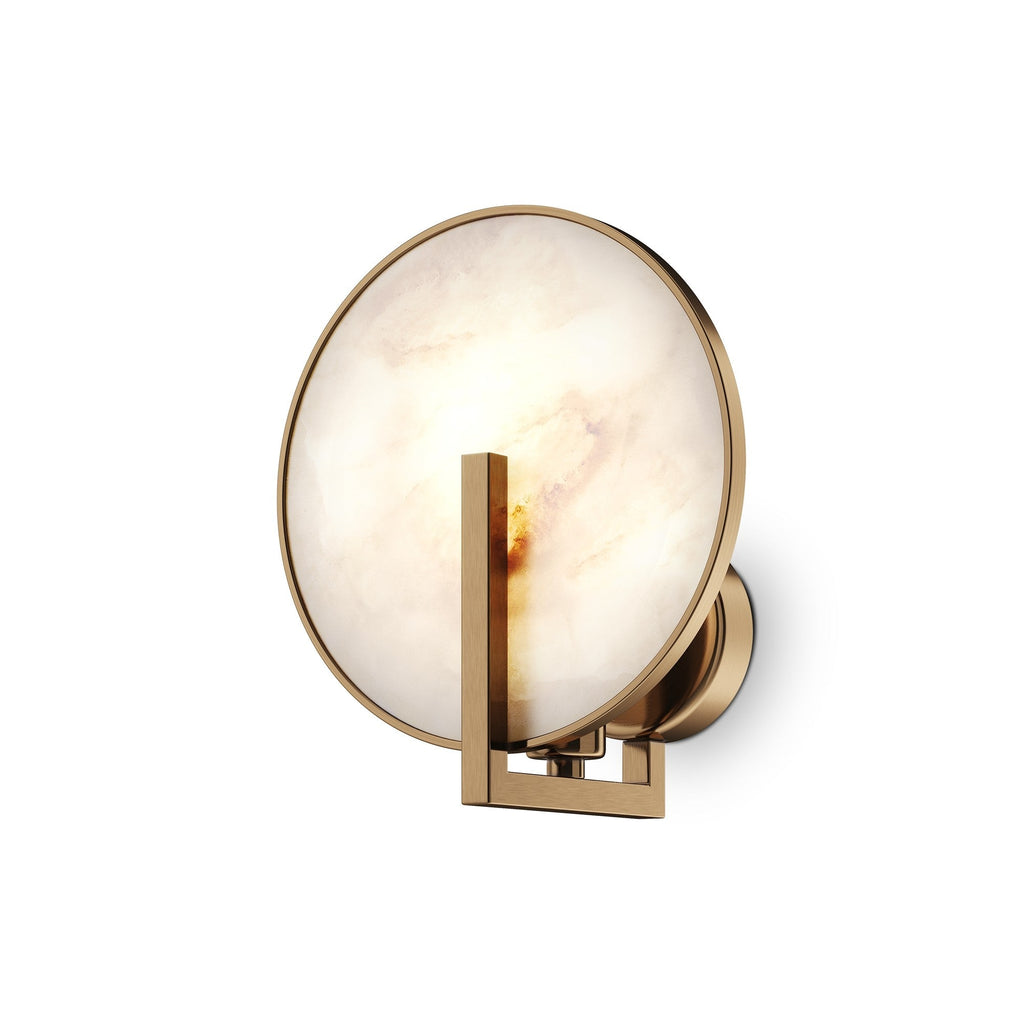
Bedrooms need soft light that does not stare back at you. In an alabaster wall light the source sits behind or inside natural stone, so what you see is a calm, glowing surface instead of a bare bulb. The Marmo wall light, for example, places a single bulb behind a natural stone disc and is designed for ambient rather than task light, which is exactly the job a bedside light should do. Because every stone is cut from a different section, a pair will look related but never identical.
Which size suits your bedside wall?
Measure the free wall between the bedside table and the nearest corner, door or window, then choose a fitting that leaves breathing room.
- Compact round: the Marmo has a 19 cm (7.5 in) diameter and a 12.5 cm (4.9 in) projection, which suits ordinary residential walls.
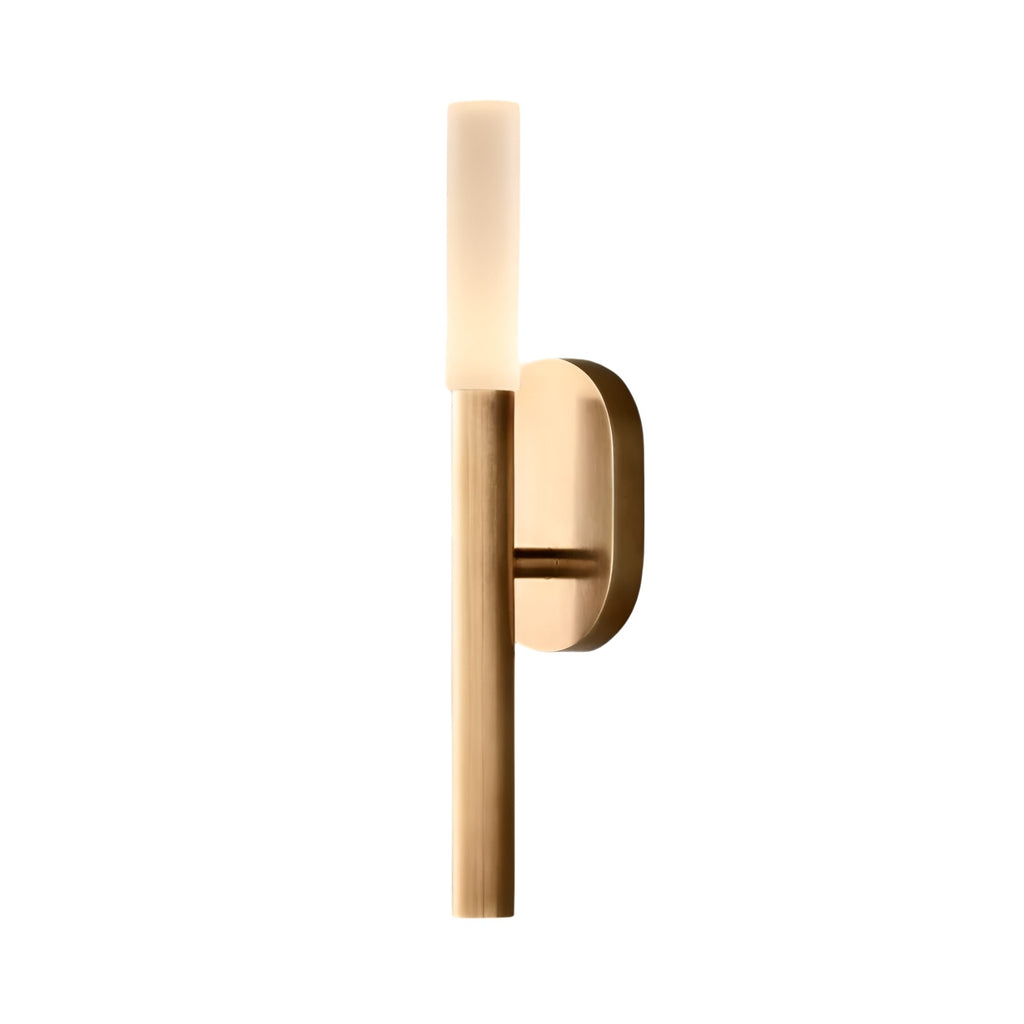
- Slim vertical: the Aurelian is 36 cm (14.2 in) tall, 7.5 cm (3 in) wide and projects 9 cm (3.5 in). Its product page lists flanking a headboard as a typical position, and its brass back plate covers a standard US wall box.
A small projection matters in a bedroom: at 9–12.5 cm (3.5–5 in) the light stays out of the way when you sit up against a pillow.
How high should bedside wall lights be mounted?
A common starting point is to place the middle of the lit stone 55–75 cm (22–30 in) above the top of the mattress, which is about 120–140 cm (47–55 in) from the floor. The glow then sits just above shoulder height when you are sitting up. Centre each light over its bedside table. For a typical double or queen bed with a table on each side, that puts the two lights roughly 1.8–2.3 m (6–7.5 ft) apart. Adjust for your headboard height and ceiling height before drilling.
How bright should they be?
- Marmo takes one E14 bulb up to 40W. Its product FAQ suggests most owners fit a warm-white LED of 4–6W at 2700K–3000K for bedroom or hallway ambience.
- Aurelian uses an integrated 3W LED at 3000K and is described as suited to bedrooms and hallway accents rather than task areas.
Alabaster is translucent, not transparent, so expect a gentle glow. If you read in bed, add a table lamp or an adjustable reading light and let the alabaster wall lights do the atmosphere. Put the wall lights on a dimmer or a bedside switch, and confirm driver and dimmer compatibility with SPACE361 before ordering.
Safety and installation
Wall lights are fixed fittings, so have a qualified electrician install them and check the voltage on the product page. The Aurelian and Marmo should be specified in 120 V configurations for US projects; confirm the exact version before ordering and check the fixture label before installation. Marmo is IP20, which means dry indoor rooms only. Keep both away from bathroom zones.
Which finishes pair well?
Gold or brushed brass frames sit well with warm timber, linen and neutral walls. Matte black or nickel finishes give a cooler, more graphic look against pale plaster.
Frequently asked questions
How far apart should bedside wall lights be?
Centre one over each bedside table. For a typical double or queen bed that is roughly 1.8–2.3 m (6–7.5 ft) apart.
Are alabaster wall lights bright enough for reading?
Not on their own. They give soft ambient light. Add a dedicated reading lamp for books.
Will two alabaster wall lights match exactly?
No. Each stone is natural, so the veining differs. That variation is a feature of the material.
Can I use alabaster wall lights in a small bedroom?
Yes. Slim fittings with a projection of about 9 cm (3.5 in) save floor and wall space.
Related reading
Keep planning
Related buying guides
 Alabaster lighting guideCan Alabaster Lights Be Used in a Bathroom? IP Ratings ExplainedOnly in the right place. Natural alabaster is porous and softer than marble, and most alabaster fixtures are rated for dry indoor use. Keep them out of showers, baths and splash zones. In a bathroom, use them only outside the zones, or choose a fitting with an explicit IP44 or higher rating for the zone.Read guide →
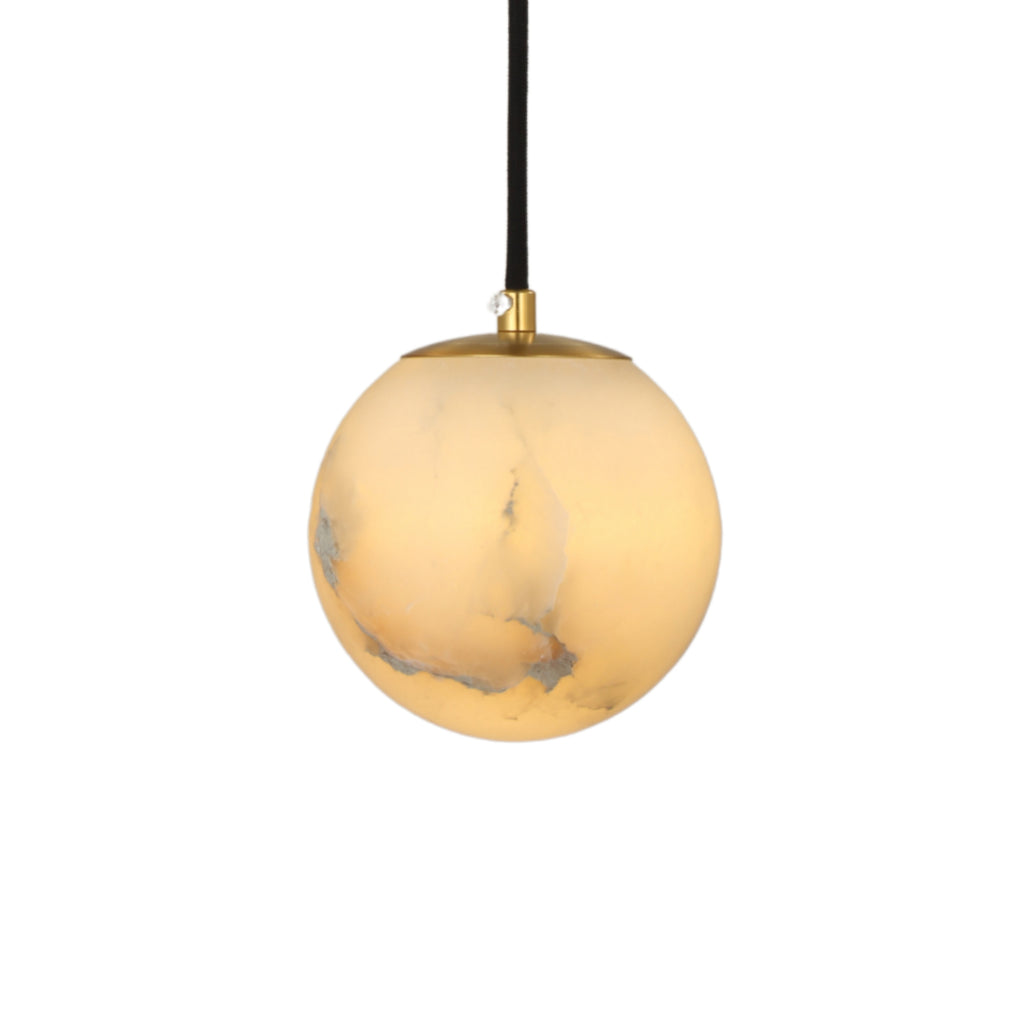 Alabaster lighting guideHow to Hang Small Alabaster Pendants in a Cluster Over a Kitchen IslandFor a kitchen island, hang an odd number of small pendants (3 or 5) at varied drops, with the lowest shade roughly 76–90 cm (30–36 in) above the counter. Space them evenly along the island, keep the group shorter than the island, and give each pendant its own cable so an electrician can set the drops.Read guide →
Alabaster lighting guideWhat Bulb Does an Alabaster Light Need? E14, G9 and Integrated LED ExplainedMost alabaster lights look best with a warm-white LED at 2700–3000K. SPACE361 fittings use three light-source types: integrated LED (nothing to change), E14 bulbs (the Marmo takes up to 40W, with 4–6W LED recommended) and G9 capsule bulbs (the Lyvane). Always match the bulb base, voltage and dimmer.Read guide →
Alabaster lighting guideAlabaster vs Marble vs Onyx vs Travertine: Which Stone Is Best for Lighting?Alabaster is the softest and most translucent of the four, so it glows evenly when lit. Marble is denser and mostly opaque, onyx is translucent with bolder banding, and travertine is warm, porous and usually opaque. Choose alabaster when you want the stone itself to act as the lampshade.Read guide →